Selection and drawings
Lamps selected to match the lighting design concept, your style and your budget, then placed on the drawings for your electricians and fitters.
Stage: Design
Start a project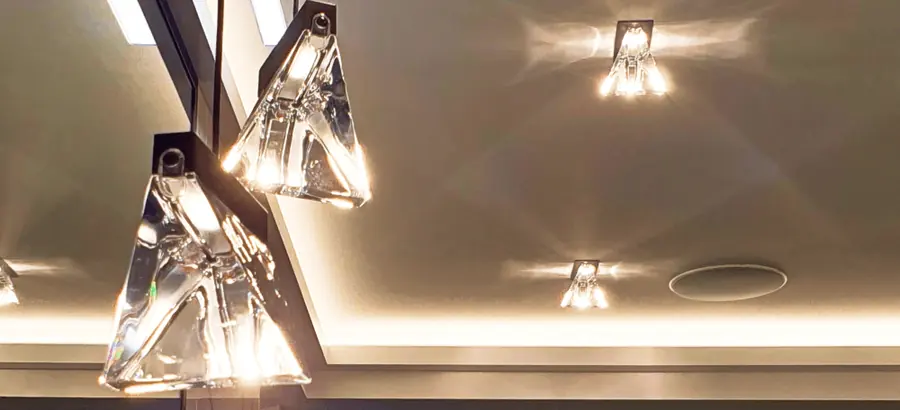
Three principles
We select lighting fixtures on three principles only: energy efficiency, style and budget.
We work directly with high-quality suppliers such as Flos, Ligman and Italamp, so the solutions we offer are up to date and meet all three.
Fixtures into drawings
Every fixture we select goes onto the drawings, ready for your electricians and fitters to work from.
Just the brands, if you prefer
Want to find out which brands of lighting fixtures your project needs? We can help with that part alone.
How we choose a fixture
Two downlights can look identical in a catalogue and behave very differently on site. These are the specs we read before anything goes on a drawing.
Flux and efficacy
Lumens and lm/W of the whole luminaire, not of the bare LED chip. The difference can be large.
Optics and beam angle
Narrow spot for accents, flood for general light, wall-washer or asymmetric optics for walls and facades.
IP and IK
IP65 or more outdoors, IP68 under water in pools, IK where fittings can be hit. In a sauna, only fittings the manufacturer rates for sauna temperatures.
Driver and dimming
Constant current or constant voltage, and a dimming protocol that matches the control system. Most flicker problems start here.
Lifetime: L70, L80, B10, B50
L80 B10 at a given number of hours means 90% of fixtures still give at least 80% of their initial flux at that point. We compare like with like.
Flicker
Low-flicker drivers, also at low dim levels. EU rules set Pst LM ≤ 1 and SVM ≤ 0.4 for mains light sources; good drivers do better.
Colour consistency
CCT, Ra and the binning tolerance (MacAdam steps), so neighbouring fixtures look the same white.
Serviceability
Replaceable driver and LED module, access from below, spare parts available. A sealed fitting means replacing the whole thing.
Beam angle in practice
The same fixture with different optics gives a pool of light, a soft wash or a sharp accent. We choose the optic per position, not per catalogue page.
Lighting control
We work with DALI, KNX, Casambi, 1-10 V and others, chosen for the project: its size, its wiring and how you want to use it.
DALI
Digital and addressable: every fitting or group on its own address, status feedback. Our usual choice for offices and larger homes.
KNX
Building automation bus, when lighting has to work together with blinds, climate and security.
Casambi
Bluetooth wireless control, useful in renovations and wherever there is no control cable.
1-10 V
Simple analogue dimming of groups, still common for technical and sports lighting.
Presence sensors
Corridors, toilets, storage, offices: light only while someone is there.
Daylight sensors
Rows near windows dim down when the sun does the job.
What goes on the drawings
Drawings are for the people who install. Everything an electrician would otherwise have to guess is written down.
- Fixture positions with setting-out dimensions
- Fixture types and legend
- Circuits and control groups
- Mounting heights
- Cable routes and lengths of low-voltage runs
- Driver positions and access hatches
- Junction boxes and access points
- Sensors, keypads and the scene table
Projects with this service
Questions we are often asked
How much does a lighting project cost?
It depends on the scope, the size of the building and the fixtures. We give a quote after we have seen the drawings.
When should a lighting designer join the project?
As early as possible, before the wiring and the ceilings are fixed. Moving a cable route on paper costs nothing; on site it means opening walls.
Can you do only the calculation, or only the supply?
Yes. Every service can be ordered on its own or as part of a full project.
Will you work with my electrician?
Yes. Your electrician gets our drawings, and we can supervise the installation.
Do you make visualisations?
Yes, for the main spaces and facades, so you can see the result before buying anything.
What is the warranty?
The manufacturer’s warranty on the fixtures, on its terms. If something fails, we handle the claim with the manufacturer for you.
It’s time to light up.